
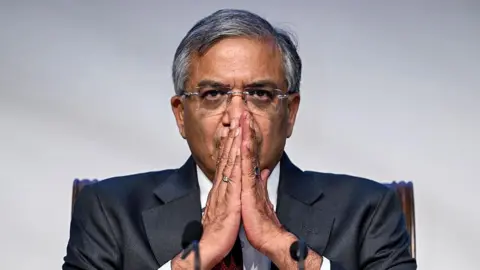


New Delhi: The Supreme Court on Monday stopped short of suspending Chief Election Commissioner Gyanesh Kumar over allegations that key decisions linked to the Special Intensive Revision (SIR) of electoral rolls were taken without the concurrence of the other two Election Commissioners.
Table of Contents
Instead, the three-judge bench headed by Chief Justice of India Surya Kant issued notices to the Election Commission, the Centre and senior poll officials, seeking a clear response to the allegations. The court indicated that if the official record eventually shows that any decision was taken in breach of the law or the prescribed decision-making process, it could intervene and reconsider those decisions.
The matter has put the functioning of the Election Commission under intense judicial scrutiny at a time when the SIR exercise itself has become a major political and legal flashpoint.
Why is the Supreme Court examining the CEC’s role?
The petitions before the court challenge the manner in which the Election Commission allegedly took around 14 decisions connected with the SIR process between October 2025 and August 2026.
The petitioners claim that Election Commissioners Sukhbir Singh Sandhu and Vivek Joshi had recorded objections to several decisions and that some orders were issued without their approval or recommendation. These allegations followed reports about differences within the poll panel over aspects of the SIR exercise.
The Election Commission, however, has maintained that differences of opinion are part of institutional deliberations and that its orders have the required legal backing and follow the prescribed procedure.
Court refuses to suspend Gyanesh Kumar for now
The petitioners had sought an immediate interim order preventing Gyanesh Kumar from functioning as CEC.
The Supreme Court declined to grant that relief at this stage.
The bench made it clear that it could not simply assume that the allegations were correct on the basis of newspaper reports. The judges said they wanted a transparent response from the Election Commission and the other respondents before considering whether any of the disputed decisions were legally sustainable.
The court’s approach leaves open the possibility of further intervention if the records support the allegations.
In other words, the CEC has not been cleared of the allegations, but neither has the Supreme Court found him guilty of any wrongdoing.
‘If the law was not followed, court can intervene’
During the hearing, the petitioners argued that the Election Commission is a multi-member constitutional body and that important decisions cannot be treated as the personal decisions of the CEC.
They relied on the statutory framework governing the Election Commission and argued that the institution’s collective character must be protected.
The bench, however, pointed out that the law itself provides for decision-making by the Commission and that where unanimity is not possible, decisions can be taken according to the applicable majority rule.
The judges therefore indicated that the crucial question is not simply whether the two Election Commissioners disagreed, but whether the statutory procedure was actually violated.
That distinction could become central to the case.
Petitioners seek records of the disputed decisions
The petitioners have asked the court to examine the original records connected with the 14 decisions.
They have also sought further investigation into allegations concerning the SIR process, including claims relating to electoral-roll data and changes to voter-related procedures.
One of the petitions seeks an independent inquiry, while another challenges the legal basis and decision-making process behind the SIR exercise.
For the Supreme Court, however, the immediate issue is narrower: were the decisions taken in accordance with the Constitution and the law governing the Election Commission?
Why the case matters
The controversy goes beyond the individual position of CEC Gyanesh Kumar.
At its heart is a larger constitutional question: how should a multi-member Election Commission exercise its powers when its members disagree?
Article 324 of the Constitution entrusts the Election Commission with the superintendence, direction and control of elections. The petitioners argue that these powers belong to the Commission as a collective body rather than to the CEC acting alone.
The Supreme Court’s examination could therefore have implications for how future decisions of the poll panel are recorded, approved and challenged.
What happens next?
The immediate next step is for the Centre, the Election Commission, the CEC and the other officials named in the petitions to respond to the Supreme Court’s notices.
The court will then have to examine the relevant records before deciding whether any of the disputed SIR decisions require judicial intervention.
For now, Gyanesh Kumar continues as Chief Election Commissioner. The Supreme Court has not suspended him and has not made any final finding that he acted unlawfully.
But Monday’s proceedings have made one thing clear: if the official record establishes that the Election Commission’s statutory procedure was not followed, the disputed decisions could face further scrutiny — and potentially judicial action.