

New Delhi, October 7, 2026: Prime Minister Narendra Modi marked 25 years as the head of a government on Wednesday with an emphatic message for the future: “We will do it.”
Table of Contents
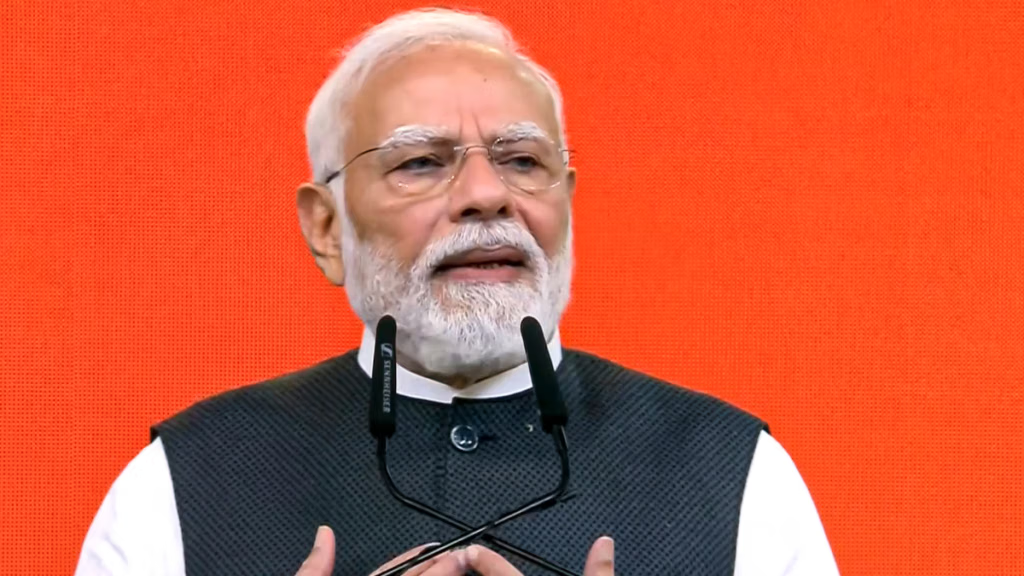
Addressing the Viksit Bharat Sankalp Sabha at Delhi’s Indira Gandhi Indoor Stadium, Modi repeatedly used the phrase while outlining his vision for India—from becoming a developed nation by 2047 to entering the world’s top three economies, achieving greater self-reliance and hosting the Olympics.
The milestone marks 25 years since Modi first took oath as Gujarat chief minister on October 7, 2001. He later became Prime Minister in 2014 and has remained at the helm of the Union government since then.
‘I will not stop until India becomes developed’
Modi used the occasion not simply to look back, but to set the tone for the years ahead.
He said his journey would continue until India achieves the goal of becoming a developed nation, stressing that the country could reach its ambitions only through sustained effort, public participation and hard work.
“This is not a time to rest,” Modi said, urging citizens to move forward with determination and devote themselves to nation-building.
His message was aimed particularly at India’s young population, which he described as a major opportunity for the country.
From Gujarat to Delhi: 25 years at the top
Modi recalled October 7, 2001, when he became Gujarat’s chief minister. He said he had not imagined at the time that he would eventually complete 25 years as a head of government.
The Prime Minister credited the people, BJP workers, NDA supporters and others who placed their trust in him for the journey.
He also framed the milestone as a collective achievement rather than a personal one.
According to Modi, the more important question is not where he has reached after 25 years, but where India has reached.
‘I still consider myself a student’
One of the more personal portions of Modi’s speech focused on the lessons he said he had learned over the years.
Recalling his school days in Vadnagar, he said his habit of reaching school early and remaining eager to learn had stayed with him.
He said success taught him humility, setbacks taught him resilience and political opposition helped him understand the importance of democracy.
Modi also referred to major events during his years in public life, including the Bhuj earthquake, the Chandrayaan programme and the Covid-19 pandemic, saying each experience had shaped his approach to public service.
Big targets: Economy, manufacturing, Olympics and space
Modi used the occasion to list several major national ambitions.
Among the targets he highlighted were:
- Viksit Bharat by 2047
- India among the world’s top three economies
- A more self-reliant India
- Strengthening India as a global manufacturing hub
- Hosting the Olympic Games
- Expanding India’s achievements in space exploration
For each ambition, Modi returned to the same message: “We will do it.”
He argued that confidence, clear policies and hard work would be critical to turning these goals into reality.
‘The country’s trust is my biggest strength’
Looking back at his political career, Modi said the support of ordinary citizens had been central to his journey.
He described the 25 years of public trust and experience as a form of national wealth rather than personal property.
The Prime Minister said he had always viewed his role as one of service and recalled the values that shaped him before he entered electoral politics.
“I am not a person who lives for ambition, but for a mission,” was the broad theme of his remarks as he described his transition from organisational work to leading governments.
From economic pessimism to a new confidence
Modi also contrasted the India he encountered in earlier phases of his political career with the country he sees today.
He pointed to developments in domestic manufacturing, technology, solar power and agriculture as evidence of changing economic confidence.
He highlighted the rise of Made-in-India mobile phones and the growing importance of solar energy, while arguing that India should now aim even higher.
He also spoke about aviation, saying he wanted a future in which the world recognised aircraft manufactured in India.
Celebrations begin in Vadnagar
The anniversary was marked by events in Vadnagar, Modi’s hometown in Gujarat, alongside the main programme in Delhi.
Modi visited the Shri Vinayak Temple in New Delhi earlier in the day and offered prayers for the welfare and prosperity of the country.
A separate service-themed motorcycle journey from Varanasi to Vadnagar also formed part of the celebrations, with hundreds of bikers taking part in events highlighting Gujarat’s cultural and historical heritage.
The celebrations came as Modi completed a quarter-century at the head of a government—a rare milestone in Indian politics.
But his speech made clear that he does not view the anniversary as an endpoint.
For Modi, the focus remains on what comes next: a developed India, greater economic strength and a country confident enough to set—and pursue—ambitious global goals.
And his message to supporters was simple: “We will do it.”