



New Delhi: The Union Budget 2026 has announced changes in import duties aimed at reducing the cost of essential goods and promoting domestic manufacturing. The government has removed customs duty on several life-saving medicines and key manufacturing inputs, while increasing taxes on liquor and stock market trading.
Table of Contents
However, officials clarified that price changes will not be immediate, as most consumer prices are governed by the GST Council and not directly by the Union Budget.
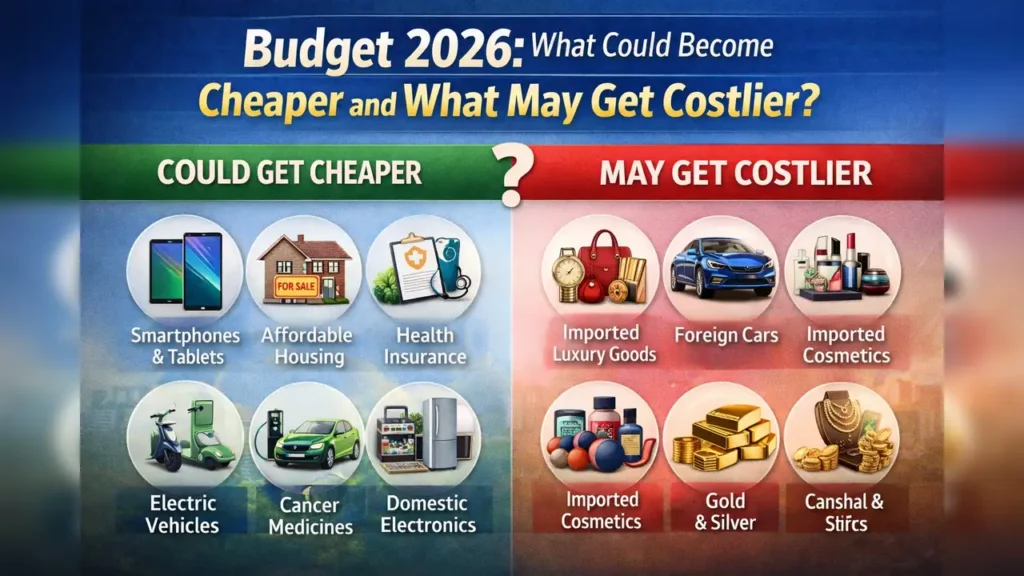
Items likely to become cheaper
Cancer medicines
The government has abolished basic customs duty on 17 life-saving cancer drugs. In addition, imported medicines and special foods used to treat seven rare diseases have been fully exempted from customs duty. The move is expected to significantly ease the financial burden on patients dependent on costly imported treatments.
Microwave ovens
Customs duty has been reduced on certain components used in the manufacture of microwave ovens. The measure is intended to boost domestic electronics manufacturing and could lead to lower consumer prices over time.
Electric vehicles and solar panels
To support the energy transition, the government has expanded tax exemptions on machinery and raw materials used for lithium-ion battery production, including battery energy storage systems. Customs duty has also been removed on sodium antimonate, a key input for solar glass manufacturing, which is expected to reduce the cost of solar panels.
Footwear, textiles and seafood
To promote exports, the duty-free import limit for seafood exports has been increased from 1% to 3%. Tax exemptions have also been extended to the export of leather and synthetic footwear, including shoe uppers. Lower input costs could help keep prices of footwear and related products stable or lower.
Foreign travel
Tax Collected at Source (TCS) on overseas tour packages has been reduced to a flat 2%, replacing the earlier rates of 5% on spending up to ₹10 lakh and 20% on higher amounts. The new rate applies without any spending cap, making international travel more affordable.
Aircraft maintenance and personal imports
Customs duty has been removed on aircraft parts and components used in manufacturing and maintenance, including defence-related MRO activities. In addition, tax on goods imported for personal use has been reduced from 20% to 10%.
Items likely to become costlier
Liquor
TCS on liquor has been increased from 1% to 2%, which may result in higher retail prices.
Stock market trading
The Securities Transaction Tax (STT) on futures trading has been raised from 0.02% to 0.05%, while the tax on options trading has been increased to 0.15%. This will increase transaction costs for investors and traders.
Why prices may not change immediately
Experts note that changes in customs duty affect only new inventory. Existing stock will continue to be sold at older prices. Moreover, companies are not legally required to pass on tax benefits to consumers, and global raw material prices also influence final retail rates.
The government reiterated that GST rates cannot be changed through the Union Budget. Any modification to GST slabs requires approval by the GST Council, which currently levies tax under two slabs—5% and 18%.