




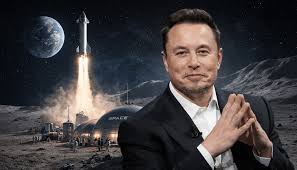


Tech billionaire Elon Musk has revealed an ambitious new vision for the future of artificial intelligence and space exploration: building a factory on the Moon to manufacture AI-powered satellites designed to capture the Sun’s energy.
Table of Contents
The announcement came during a 45-minute internal meeting of Musk’s AI company, xAI, the video of which was recently shared online. In the meeting, Musk outlined a sweeping plan that blends artificial intelligence, space infrastructure, and long-term human expansion beyond Earth.
Tapping Into the Sun’s Vast Energy
Musk argued that humanity currently uses only a fraction of the energy available to it. According to him, modern civilization consumes just about 1% of the potential energy accessible on Earth. However, if humans were able to capture even one-millionth of the Sun’s total energy output, it would amount to roughly a million times more power than humanity uses today.
“The Sun accounts for 99.8% of the mass in our solar system,” Musk said, emphasizing that meaningful access to such energy would require moving beyond Earth-based infrastructure.
Moon-Based Factories and a “Mass Driver”
As part of the plan, Musk proposes building factories on the Moon that would manufacture AI satellites. These satellites would then be launched into deep space using a “mass driver,” an electromagnetic launch system that could propel objects without traditional rocket fuel. Because the Moon’s gravity is much weaker than Earth’s, launching from its surface would require significantly less energy.
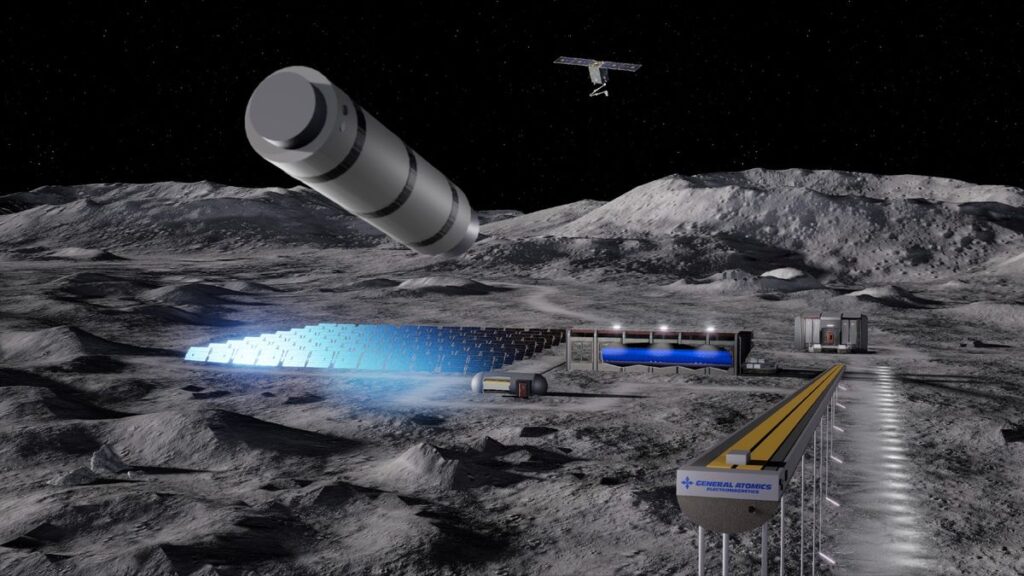
The satellites, once deployed, would gradually form a vast solar energy collection network around the Sun. Musk’s concept draws inspiration from the theoretical “Dyson Sphere”—a megastructure envisioned to surround a star and harvest its energy output.
If successful, such a system could provide enough energy to support human settlements throughout the solar system and power extremely large spacecraft.
Major Restructuring at xAI
During the meeting, Musk also disclosed significant organizational changes within xAI. Of the 12 original founding team members, only six remain. Musk described the departures as part of a broader restructuring effort aimed at accelerating progress.
The company is now divided into four main teams:
- Grok Team: Focused on chatbot and voice technology.
- Coding Team: Working on strengthening and automating system infrastructure.
- Imagine Team: Dedicated to advanced video generation tools.
- Macrohard Project: A high-level initiative focused on large-scale digital simulations.
“Macrohard” and Digital Company Simulations
The Macrohard project aims to go beyond traditional software development. Musk described a future where AI can create full digital simulations of entire companies—modeling departments, supply chains, and decision-making processes. Major business decisions could then be tested virtually before being implemented in the real world.
One of the project’s boldest goals is to enable AI to design complex machines, including rocket engines. Musk suggested that AI-driven engineering could dramatically reduce human error and accelerate innovation.
The Future of Coding
Musk predicted that traditional coding may soon become largely unnecessary. He claimed that by the end of the year, AI systems could generate programs directly in binary—the computer’s native language—without relying on human-written code or compilers.
He also suggested that xAI’s “Grok Code” could become one of the world’s most advanced coding models within the next few months.
AI-Generated 20-Minute Videos
The Imagine team is reportedly developing models capable of generating 10- to 20-minute videos in a single pass, without human intervention. If achieved, this could significantly reshape digital content creation.
The “Memphis Cluster” Supercomputer
Musk highlighted what he described as the world’s largest GPU cluster, operating around the clock to train future versions of the Grok AI model. A significant portion of the data center was built in just six weeks and includes over 1,300 kilometers of fiber-optic cabling. Once fully operational, the facility is expected to consume more than one gigawatt of electricity.
In a characteristically playful move, Musk said the words “Macro Hard” were written on the roof of the data center—widely interpreted as a tongue-in-cheek jab at Microsoft.
The Vision of an “Everything App”
xAI’s voice team revealed that, despite having no voice model as recently as September 2024, they developed a competitive system within six months. Musk’s broader ambition is to turn the platform into an “everything app,” combining AI chat, voice interaction, payments, content, and other services in one ecosystem.
While experts note that many aspects of Musk’s lunar factory and solar energy network would require unprecedented technological breakthroughs, the proposal reflects his long-standing philosophy: think on a planetary scale—or even beyond it.
Whether visionary or wildly optimistic, Musk’s latest plan once again pushes the boundaries of what might be possible in the decades ahead.


